
Blog · Maintenance strategy
Reactive vs preventive maintenance: what the difference really costs.
Every maintenance team sits somewhere on the line between firefighting and planning. Here is what each end of that line costs — and a practical way to move up it without growing headcount.
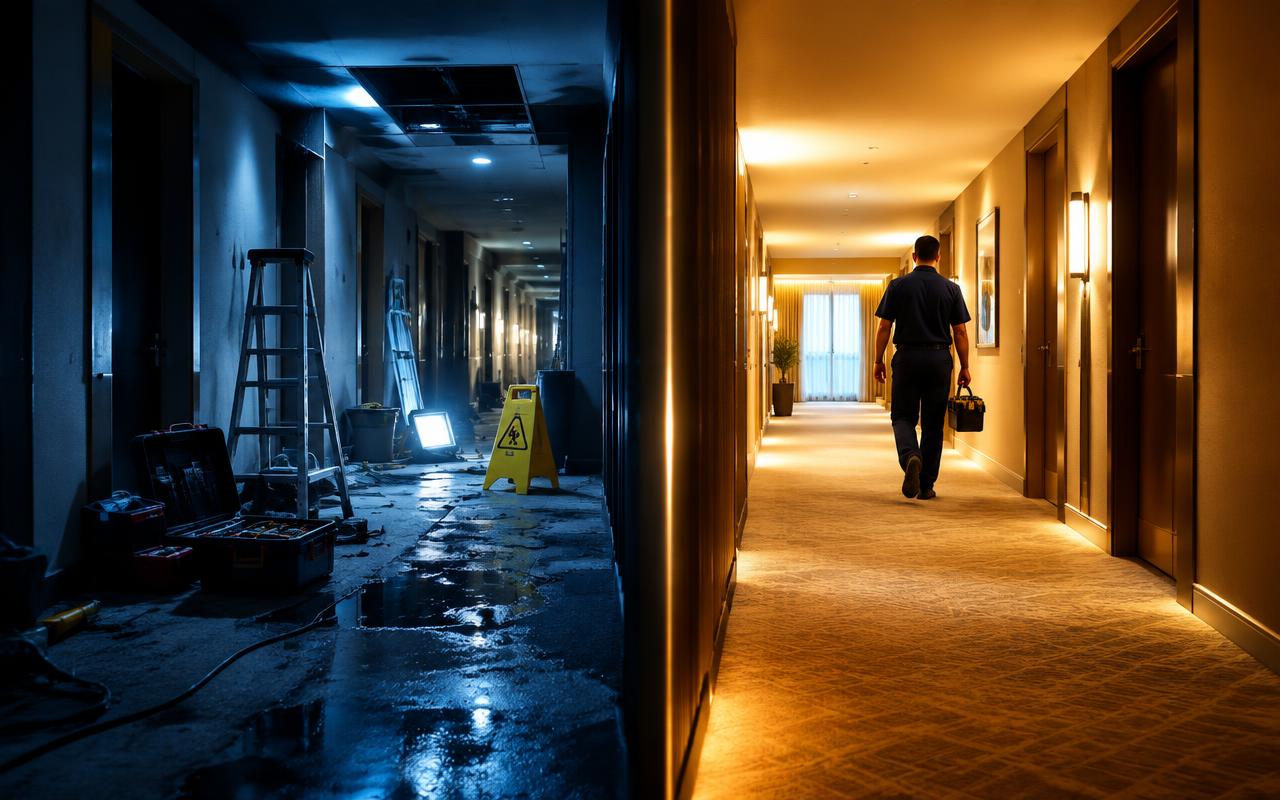
Two ways to run the same building
Reactive maintenance waits for something to break, then fixes it fast. Preventive maintenance follows a schedule — time-based, meter-based or condition-based — so most failures never happen. Both approaches keep the lights on. They do not cost anything like the same amount.
Industry studies consistently put the same repair done reactively at 2–4x the cost of the same job done as planned work. In hotels and residential towers, the multiplier is usually at the higher end, because failures land on guests and residents — the people least able to wait.
Where the extra money actually goes
Premium labour
Emergency call-outs and overtime rates replace scheduled shifts. A pump swap planned for Tuesday costs one tech hour; the same swap at 2am on a Friday costs three.
Last-minute parts
Reactive teams buy parts at emergency prices with express delivery — or cannibalise stock from other jobs, creating the next breakdown.
Secondary damage
A stuck AHU valve ignored long enough takes out the motor and floods the ceiling. The failure you pay for is rarely the first one.
Guest and resident impact
In an occupied room, a breakdown means comped nights, moves and reviews. In a tower, it means complaints to the owners association. This cost never appears on a maintenance budget line.
Shortened asset life
Equipment that runs to failure is replaced years earlier than equipment that is serviced. Reactive spend quietly converts capex into opex at the worst possible price.
Management time
Firefighting consumes supervisor hours in coordination, apologies and re-planning — time that planned work lets them spend on contractors and capex.
The ratio that predicts your budget
One number tells you where you stand: the share of completed work orders that were planned. Track it for a month and the pattern is familiar — teams below 50% planned are the ones whose cost per room climbs every year, whose stores are always short, and whose engineers describe their job as "running around".
The goal is not 100% preventive. Some reactive work is inevitable and even healthy — no schedule predicts everything. A healthy operation runs 70–80% planned, holds a small reactive capacity in reserve, and reviews every breakdown to ask whether it deserved a schedule.
How to shift the ratio without hiring
1. Start with the assets that hurt most. You cannot schedule everything at once. Pick the 20% of assets that generate 80% of your emergency calls — usually HVAC, kitchen equipment, pumps and lifts — and build their PPM plans first.
2. Turn history into schedules. Every reactive work order on an asset is evidence. An asset repaired three times in a year earns a preventive task; the fourth repair should be a replacement case, not another call-out.
3. Make PPM visible. Schedules that live in spreadsheets quietly die. Planned tasks should sit in the same queue as breakdowns, with completion tracked like any other work.
4. Budget the shift. Moving to 70% planned typically costs a little more in scheduled hours in year one and repays it in avoided emergencies from year two. Present it to ownership as an investment with a payback, not an expense.
Let the system hold the ratio
BKORA was built to move teams up this line: preventive maintenance schedules generate the planned work, work orders capture every breakdown against its asset, and reporting shows your planned-vs-reactive ratio and cost per room month by month. See how it works for hotels and residential buildings.
Frequently asked questions
What is the difference between reactive and preventive maintenance?
Reactive maintenance fixes equipment after it fails; preventive (planned) maintenance services it on a schedule or condition trigger before it fails. The same job done reactively typically costs 2–4x more because of emergency call-outs, overtime, guest or resident disruption and secondary damage.
What percentage of maintenance should be preventive?
A healthy target is 70–80% planned work. Below 50%, engineering teams spend most of their day firefighting, costs per room or per square foot climb every year, and equipment life shortens noticeably.
Why is reactive maintenance more expensive?
Emergency work carries premium contractor rates and overtime, parts are bought at last-minute prices, failures cause secondary damage, and in hotels a breakdown in an occupied room can trigger compensation or a bad review worth far more than the repair itself.
See BKORA on your property.
A 30-minute demo tailored to your portfolio, brand standards and team.